Why Marble — and Where It Belongs in a Lake Norman Home
Marble is the third major stone countertop material Lake Norman homeowners consider alongside quartz and granite. It is not the practical default for a busy family kitchen — quartz earns that role for most Huntersville and Cornelius households — and it is not the right pick for an outdoor grill island. Where marble earns its keep is as a deliberate material choice for a master-bath vanity, a fireplace surround, a baking-station island, or a butler's pantry where the homeowner is willing to wipe down the surface after use.
The trade-off is real and worth being honest about. Marble etches from acids (lemon juice, wine, vinegar), scratches more easily than granite or quartzite, and asks for sealing on a 1–3 year cadence. In return, it offers a depth of veining and a warmth no engineered stone replicates, and it remains the material the housing market reads as the high-end accent surface. A Lake Norman homeowner who is choosing marble for the right room — and who has been told upfront that it will patina — almost always ends up happy with the result.
Marble Types: Carrara, Calacatta, and Cultured
Not every "marble" countertop is the same material. Lake Norman fabricators sell three distinct types under the marble umbrella, and the differences in cost, look, and care are significant.
Carrara Marble
Carrara is the most common natural marble and the type most homeowners picture when they think of marble countertops. It comes from the Carrara region of Italy and shows soft grey veining on a white-to-light-grey background. The veining is generally finer and more diffuse than Calacatta's, which gives Carrara a calmer overall look. Carrara is widely stocked by Lake Norman and Charlotte-area fabricators, sits mid-range on the marble pricing tier, and is the practical entry point for natural marble. Most Lake Norman bathroom vanity projects that ask for marble end up with Carrara.
Calacatta Marble
Calacatta is also quarried in Italy but from a different region than Carrara. The veining is bolder, often warmer (gold or amber tones in addition to grey), and runs across a brighter, whiter background. Calacatta is rarer than Carrara — quarried in smaller volumes and with stricter grading — which is what pushes it to the top of the marble price tier. A Calacatta kitchen island or fireplace surround is the look most homeowners mean when they say "real marble," but the cost premium is real and Calacatta is not something every Charlotte-area shop keeps in regular inventory.
Cultured Marble
Cultured marble is not a natural stone. It is engineered — cast polyester resin with crushed limestone and marble dust, finished with a gel coat that gives it the look of polished marble. The practical upside: it is non-porous, never needs sealing, and costs less than natural stone. The look is more uniform than natural marble — fewer veins, less depth — but for Lake Norman bathroom vanity tops and shower surrounds where homeowners want the marble aesthetic at a lower price point, cultured marble is the most common pick. Many new-build homes in Huntersville and Cornelius have cultured marble in at least one bathroom for exactly this reason.
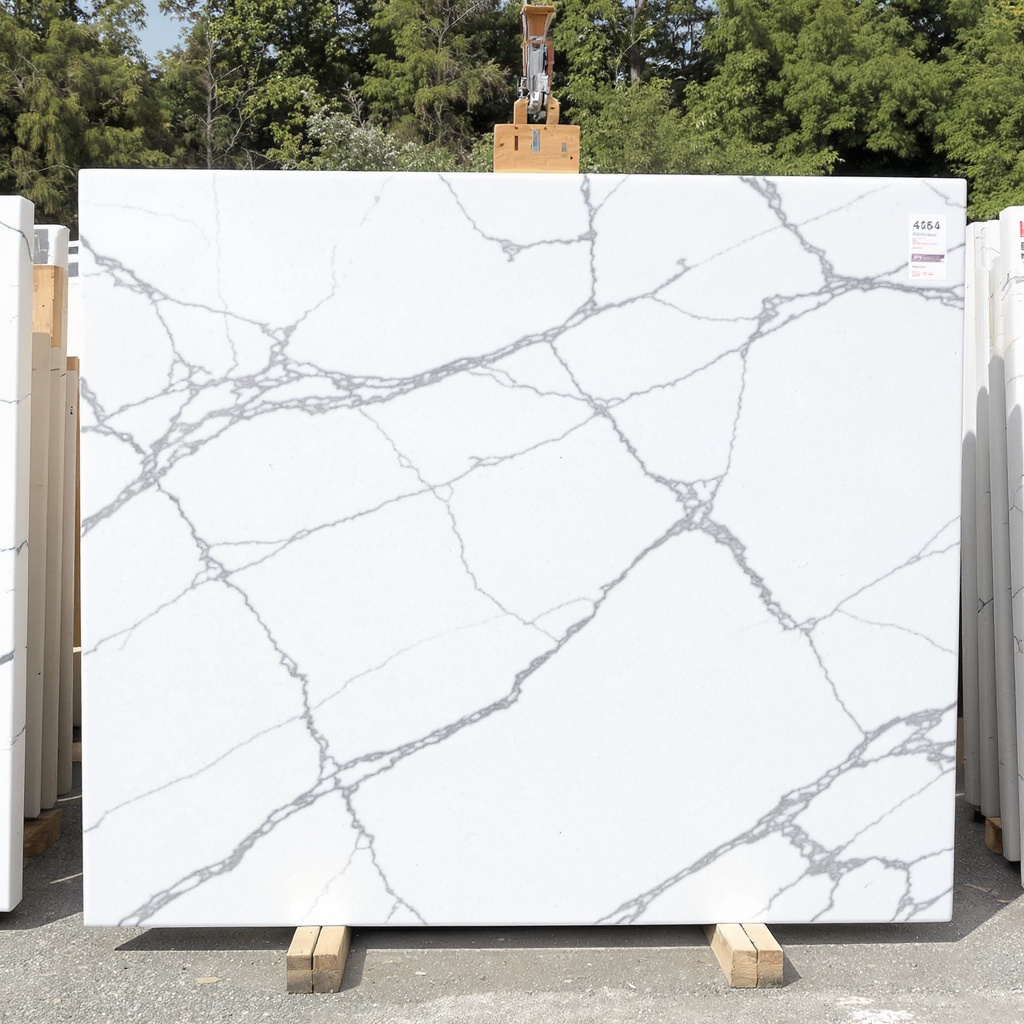
Carrara vs. Calacatta vs. Cultured Marble
Side-by-side on the properties that matter most to a Lake Norman homeowner comparing marble options:
| Property | Carrara | Calacatta | Cultured Marble |
|---|---|---|---|
| Veining | Soft grey, fine, diffuse | Bold gold or grey, on bright white | Uniform, faint pattern, gel-coat finish |
| Cost tier (installed Lake Norman mid-2026) | Mid — sits within $70–$150 marble band | Upper end — towards the top of the marble band | Below natural marble — usually $40–$90 installed |
| Maintenance | Seal at install, re-seal every 1–3 years | Seal at install, re-seal every 1–3 years | None — non-porous, no sealing |
| Etching from acids | Yes — lemon, wine, vinegar | Yes — same acids | Minimal — gel coat resists most staining |
| Best use | Bathroom vanities, accent islands, fireplace surrounds | Statement islands, fireplace walls, primary vanities | Bathroom vanity tops, shower surrounds, secondary baths |
Pros and Cons of Marble Countertops
Marble is a beautiful surface that asks for more care than any other stone a Lake Norman homeowner is likely to consider. Before committing, walk through the trade-offs you are accepting.
Pros
- Each slab is unique — natural veining that engineered stone cannot fully replicate
- Heat-tolerable — handles hot pots better than quartz (use a trivet, but it will not scorch from a brief contact)
- Reads as the classic high-end surface — perceived value gain in kitchens and primary baths
- Widely available across all three Lake Norman NC towns (Huntersville, Cornelius, Davidson) through Charlotte-area fabricators
- Carrara and Calacatta develop a soft patina over time that many homeowners consider part of the material's character
Cons
- Etches from common acids — lemon juice, red wine, vinegar, hot sauce leave dull marks on a polished surface
- Scratches more easily than granite or quartzite — cutting boards are required, not optional
- Needs sealing at install and again on a 1–3 year cadence — skipped sealing leads to staining
- Not rated for outdoor kitchens — UV, humidity, and freeze/thaw cycles are too aggressive for natural marble
- Not the right pick for a high-spill cooktop zone in a busy family kitchen — quartz handles that workload better
Care Requirements
Marble is not a maintenance-free surface. Lake Norman homeowners who are happy with their marble five and ten years out are the ones who understood the care routine before the slab was installed.
Seal the marble at installation and re-seal on a 1–3 year cadence. A quick water-bead test tells you when the sealant has worn down — if water soaks into the surface rather than beading up, it is time. Use only pH-neutral cleaners (avoid vinegar, lemon-based, or ammonia cleaners, even though they are marketed for kitchens). Wipe up acidic spills promptly — a lemon wedge that sits on the surface for an hour will etch polished marble. Use cutting boards rather than cutting on the stone directly, and use trivets under hot pans even though marble handles brief heat contact well. Avoid letting standing water sit overnight, particularly around a bathroom-vanity sink where water spots will accumulate.
For the full stone care FAQ — including sealing product recommendations and what to do about an existing etch — see our Lake Norman stone care guide.
Pricing Tier
Installed marble in the Lake Norman NC market runs roughly $70–$150 per square foot as of mid-2026, which puts marble above the typical quartz range ($60–$120) and well above the granite entry tier ($40–$55). Within the marble band, cultured marble sits at the low end (often comparable to mid-grade granite), Carrara sits in the middle, and Calacatta sits at the top.
The biggest cost drivers on a marble project are the same as for any stone: edge profile (a straight eased edge is baseline; ogee, dupont, laminated, mitered, and waterfall edges add $15–$40 per linear foot), sink and cooktop cutouts (each adds roughly $200–$400), and seam count across an island. Marble slabs also tend to book-match less predictably than quartz, which can add fabrication time and seam work on larger projects. Get an itemized quote that bundles templating, fabrication, and installation so you can compare Lake Norman fabricators apples-to-apples. See the full countertop cost guide for the side-by-side material comparison.
Want to see Carrara, Calacatta, and cultured marble in real Lake Norman installs? → View Project Gallery
Is Marble the Right Pick for Your Project?
Choose marble if the surface is in a room where you will wipe it down after use and you want a natural-stone statement — a master-bath vanity, a baking-station island, a butler's pantry, or a fireplace surround. For a high-traffic family kitchen, a busy bathroom, or any outdoor kitchen, quartz and granite will serve you better. Cultured marble earns its place when you want the marble look in a secondary bath at a lower installed cost and zero maintenance.
The most reliable way to decide is to look at actual slabs at a Lake Norman fabricator's yard and ask which Carrara or Calacatta you would want in your home, then get two itemized quotes. Birkdale Stone connects Huntersville, Cornelius, and Davidson homeowners with vetted local fabricators who keep marble in regular inventory.
Related Resources
- Lake Norman countertops overview — the wider service area across Huntersville, Cornelius, Davidson, and Mooresville.
- Project gallery — real quartz, granite, and marble installs from Lake Norman homeowners.
- Contact / free estimate — get connected with a vetted local fabricator within one business day.
- Granite vs quartz countertops — the comparison guide that pairs with this marble guide.